I painted the same window twelve times over the course of four months. Not the same painting twelve times — twelve separate studies, each one starting fresh, each one trying to understand something different about the same subject. The window faces north. It gets a particular quality of light in the afternoon, diffuse and slightly cool, that I kept failing to capture. So I kept trying.

The first study was about the light itself. I was trying to nail the color temperature, the way the light coming through the glass was slightly different from the light in the room. I got it wrong. The second study was about the shadow the frame cast on the wall. I got that wrong too, but in an interesting way — the shadow was more complex than I'd thought, it had a penumbra that changed throughout the afternoon. The third study was about the glass itself, the slight distortion of the view through it.
By the sixth study, I had stopped thinking about what I was trying to capture and started thinking about what the window was. Not as a subject, but as a thing. A window is a membrane. It separates inside from outside while allowing light and sometimes air to pass through. It's a threshold. The painting I was trying to make wasn't about light — it was about thresholds.
This is what repetition teaches you. Not technique, though technique improves. Not observation, though observation sharpens. What repetition teaches you is what you're actually looking at. The first few times you paint something, you're painting your idea of it. Your preconceptions. Your visual shorthand. The thing you think a window looks like. After enough repetitions, the preconceptions start to dissolve and you start to see the actual thing.
The handcraft and texture of painting is inseparable from this process. Each study was physically different — different paint consistency, different brush pressure, different approach to the surface. The material knowledge accumulated alongside the visual knowledge. By the twelfth study, I knew how to paint that window in a way I couldn't have known before the first eleven.
There's a concept in music called "woodshedding" — the practice of taking a difficult passage and playing it slowly, repeatedly, until it becomes automatic. Painters have an equivalent, though it's less formalized. The study is the painter's woodshed. You take the difficult thing and you do it again and again until you understand it. Not until you can do it perfectly — until you understand it. Those are different goals.
The creative community I've been part of has been talking a lot about process lately. There's a tendency in contemporary art discourse to focus on the finished work, the concept, the statement. The studies — the repetitions, the failures, the incremental understanding — get left out. But the studies are where the work actually happens. The finished painting is the result of the studies. It's not the work itself.
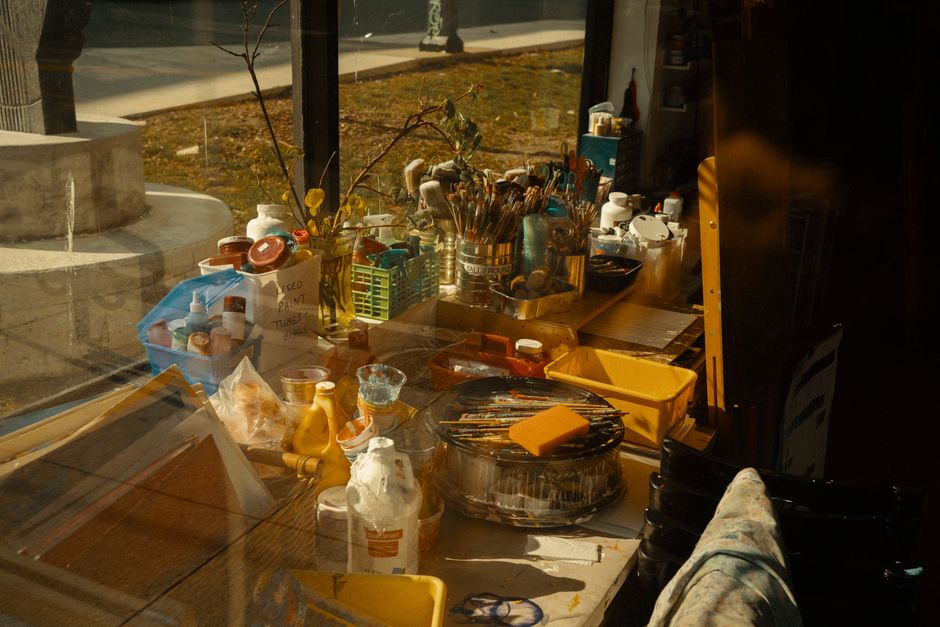
By the tenth study, I had a problem I hadn't anticipated: I was getting bored. Not with the window — with my own approach to it. I'd found a way of painting it that worked, and I was repeating that instead of repeating the subject. I had to deliberately break my own approach. The eleventh study was painted with a palette knife instead of brushes. The twelfth was painted in a single session without any preliminary drawing, just looking and responding.
The twelfth study is the one I kept. Not because it's the best — the eighth is probably the most technically accomplished. But the twelfth has something the others don't. It has the accumulated knowledge of the previous eleven, but it also has a freshness that comes from the constraint I imposed. It looks like I painted it quickly, which I did. But I couldn't have painted it that way without the eleven studies that came before.
The maker mindset that I find most useful is the one that treats repetition not as a failure to get it right the first time, but as the method itself. You don't repeat because you failed. You repeat because repetition is how you learn what you're actually trying to do. The first attempt is a hypothesis. The subsequent attempts are the experiment.
I'm starting a new series now. Different subject — a chair in the corner of my studio that I've been ignoring for years. I'm going to paint it twelve times. Maybe more. I already know I don't know what I'm looking at. That's the point.
The fine art process is not about getting it right. It's about getting closer to understanding what "right" means for this particular thing, in this particular light, on this particular day. Twelve studies of the same window taught me that. I'm still learning what it means.