Painting the Same Subject Forty Times
Monet had his haystacks. Cézanne had his mountain. There's something that happens when you commit to a subject long enough to stop seeing it the way you first saw it — when the initial impression wears off and you're left with the actual thing.
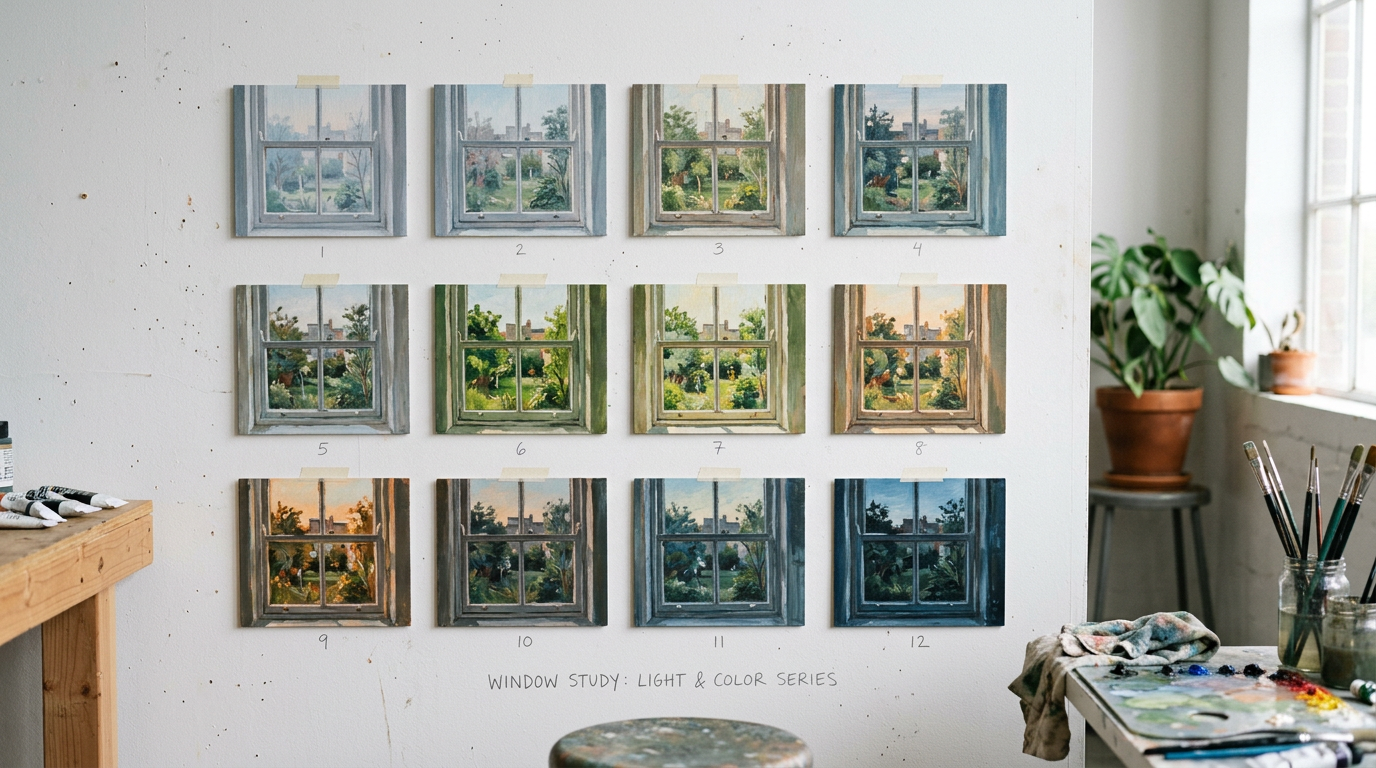
I've been painting the same window for three months. Not the view through it — the window itself. The frame, the light on the glass, the way the shadow falls differently at 7am than at 4pm. Forty-three paintings so far. I stopped counting after forty and then kept going.
What Changes
The first ten paintings were about getting the proportions right. The next ten were about light. Around painting twenty-five, I stopped thinking about the window and started thinking about what I was actually trying to say about it. That's when the work got interesting.
Repetition removes the novelty problem. When you paint something once, you're partly painting your excitement about painting it. When you paint it forty times, the excitement is gone and what's left is either something real or nothing. Most of the time it's something real.
The painting process archive has some related material on sustained observation — how long-term engagement with a subject changes what you see.
The Practical Problem
Forty paintings of the same subject takes up a lot of space. I've been working small — 8x10 inches — partly for practical reasons and partly because small paintings force a kind of economy. You can't hide in a small painting. Every mark is visible.
The creative community has been talking about series work — how committing to a series changes your relationship to individual pieces. When each painting is part of a larger project, the pressure on any single painting decreases. You can afford to fail on painting thirty-seven because painting thirty-eight is coming.
What I've Learned
The window looks different in rain. It looks different when I'm tired. It looks different after I've been away from the studio for a week. These differences are information. They're not inconsistencies to be corrected — they're data about perception, about how seeing is never neutral.
The handmade goods world has a version of this — the craftsperson who makes the same object hundreds of times and finds that the hundredth version is qualitatively different from the first. Not better, necessarily. Different in a way that only repetition produces.
More series work and process notes at Calitoy Muse.