Painting in Low Light: What You Lose and What You Find
The edges of the canvas catch less and less as the afternoon thins. What had been a clear cadmium yellow now pulls toward ochre, the warmth draining into something cooler, harder to name. The studio air thickens with linseed, a sharp green note that rises when the window light drops.
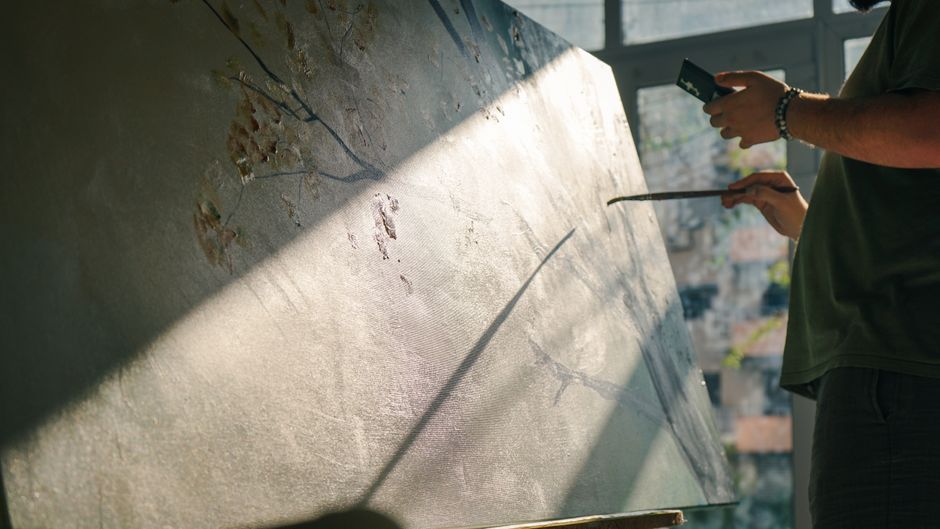
The lamp clicks on. Its beam carves a circle across the palette board. Colors inside that circle shift again. A viridian that held its depth by daylight now sits flat, almost brown at the edges where the light thins. One mixes with memory of the morning session rather than with the eye alone.
Texture changes too. The canvas tooth feels sharper under the fingertips when the eye cannot confirm every ridge. Brushstrokes that looked even in full light now leave small ridges that catch the lamp and throw tiny shadows back at the painter. These shadows become part of the mark.
Red oxide on the palette loses its brick warmth first. It turns toward earth. The painter adds a trace of white to lift it, then stops. The addition reads too cool against the already cooled ground. The correction must wait for another morning.
One learns this through adjusting for artificial sources over repeated sessions. The same tube behaves differently when the bulb is replaced with a cooler LED. The difference is small on the tube label yet decisive on the canvas.
Value over hue
Form begins to matter more than local color. A shoulder that read as warm flesh in daylight now registers mostly as a sequence of dark and light planes. The painter follows those planes with less regard for the pigment name. The result is often quieter, more structural.
Smell returns as a guide. When sight is limited the nose registers the difference between fresh turpentine and older, thickened solvent. The latter clings longer to the brush handle and alters how paint slips across the bristles. The painter pauses, wipes the ferrule, and continues.
Small decisions accumulate. A highlight that would have been pure titanium now receives a dot of yellow ochre to keep it from jumping too far forward. The adjustment is made by touch as much as by sight, the brush tip testing the thickness of the paint film before it leaves the surface.
These evening hours also reveal what daylight conceals. A passage that seemed resolved in the morning shows its seams once the strong light is gone. The painter works back into those seams with a smaller brush, softening edges that had been left crisp.
Further adjustments come from shadow studies in oil that record how the same mixture behaves when the only illumination is a single low bulb. The studies sit pinned to the wall, their muted tones serving as reference when the current canvas threatens to drift too warm or too cool.
What remains visible
Edges soften. Contours that daylight would separate now merge. The painter accepts the merger and works across it rather than against it. The brush moves in longer strokes, letting adjacent colors meet without a hard boundary.
josephcalitoy.com's notes on dusk sessions describe a similar surrender. The writer observes that once hue is unreliable the hand relies on pressure and angle. The canvas records those pressures as variations in thickness that catch the low light differently than flat passages do.
The painter stands back. From three steps away the lamp reaches only part of the surface. The rest falls into near darkness. What remains visible is enough to judge overall balance. The rest is trusted to the next day’s light.
By the time the session ends the palette has cooled further. Scraps of paint left on the glass show a dusty cast. The painter covers them with a sheet of wax paper and turns off the lamp. The studio returns to its own darkness, carrying the faint trace of solvent and the memory of the colors that will look different again at sunrise.
These evening palette adjustments accumulate into a private record. Over months the painter begins to recognize which pigments hold their identity longest when the light fails. That knowledge stays in the hand even when the eye must wait for morning.