Artificial light flattens some things and sharpens others. Painting under it is a different discipline than painting in daylight — not worse, just different. I've been doing it more lately, and I've started to understand what I'm actually working with.
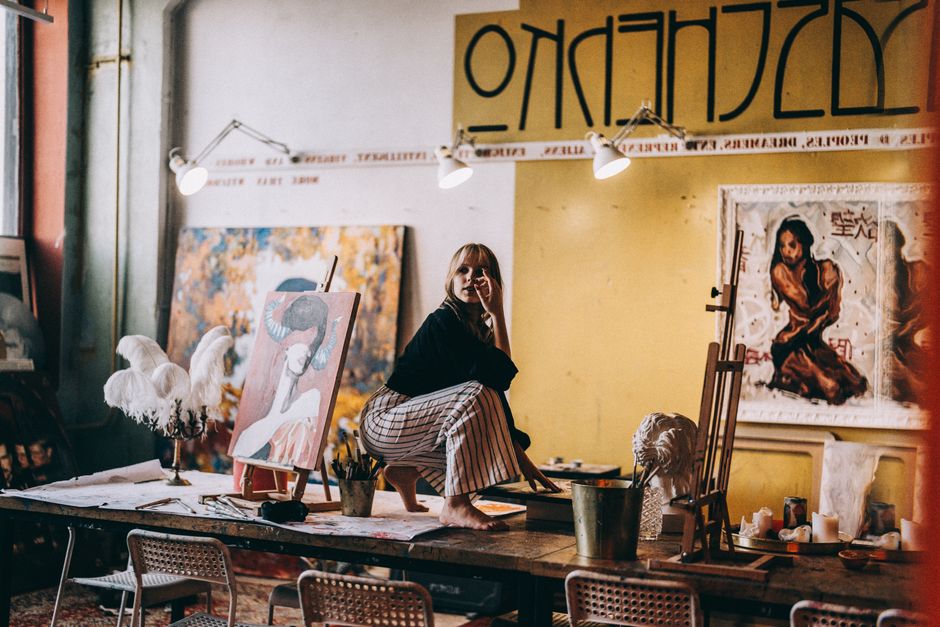
The first thing you lose is the warm-cool relationship. Daylight has a natural temperature shift — cooler in shadow, warmer in light, or the reverse depending on the time of day and the sky. Artificial light, especially LED or fluorescent, tends to be more uniform. The shadows don't cool the way they do in natural light. This means you have to manufacture the temperature contrast yourself, which is harder than it sounds because you're working without the reference.
What you gain is consistency. The light doesn't change. You can work for six hours and the shadows are in the same place at the end as they were at the beginning. For certain kinds of fine art and painting — especially anything that requires sustained observation of a single setup — this is genuinely useful. The still life doesn't shift. The model doesn't have to move with the sun.
The color problem is real, though. I've finished paintings under artificial light that looked completely different in daylight. The reds were wrong. The blues had a cast I hadn't seen. This is a calibration issue — your eye adjusts to the light source, and you stop seeing the cast. The solution is to check your work in daylight periodically, or to use a daylight-balanced bulb and accept that it's an approximation.
There's a specific quality to studio practice and texture under artificial light that I've come to appreciate. The shadows are harder. The transitions are more abrupt. This can make the work feel more graphic, more deliberate. Some painters prefer it for exactly this reason — it forces a kind of decision-making that diffuse natural light doesn't require.
I've been thinking about what morning light and intention means for a painter who works at night. There's something about the quality of attention that changes after dark. The world outside the studio stops being a distraction. The work becomes the only thing.
The creative community I know is split on this. Some painters won't work under artificial light at all. Others have built their entire practice around it. I'm somewhere in the middle — I prefer daylight, but I've stopped treating artificial light as a compromise. It's a different condition. It produces different work. That's not a problem. That's just what it is.
The painting I'm most proud of from this year was done entirely under a single LED lamp at 11pm. The colors are slightly wrong in daylight. I don't care. The painting is right.